

An outfit formula is a repeatable structure, not one exact look. “Fitted top + wide-leg trousers + short layer + streamlined shoe” is a formula; the black turtleneck, gray trousers, cropped jacket, and loafers you wear today are one version of it. Formulas make getting dressed faster because they reduce the number of decisions without forcing you into a uniform.
This guide is for women who have clothes but still rebuild every outfit from zero. You will get 15 easy outfit formulas for casual days, work, weekends, evenings, and changing weather, plus a system for adapting them to your proportions and wardrobe. Beauty AI fits after the first draft: photograph two versions, get focused feedback, and save the formula that works best.
What makes an outfit formula useful?
A useful formula has a clear job and flexible slots. It survives substitutions: sneakers can become loafers, a blazer can become a cardigan, and straight jeans can become trousers while the visual logic remains intact.
| Formula slot | The decision it solves | Examples |
|---|---|---|
| Base | What sits closest to the body? | Tee, tank, shirt, fine knit, simple dress |
| Main piece | What defines the silhouette? | Jeans, trouser, skirt, dress, jumpsuit |
| Layer | What adds structure, warmth, or contrast? | Blazer, cardigan, overshirt, trench, cropped jacket |
| Shoe | How formal, practical, or elongated should it feel? | Sneaker, loafer, boot, flat, heel, sandal |
| Finish | What makes the look intentional? | Belt, bag, jewelry, color echo, rolled sleeve |
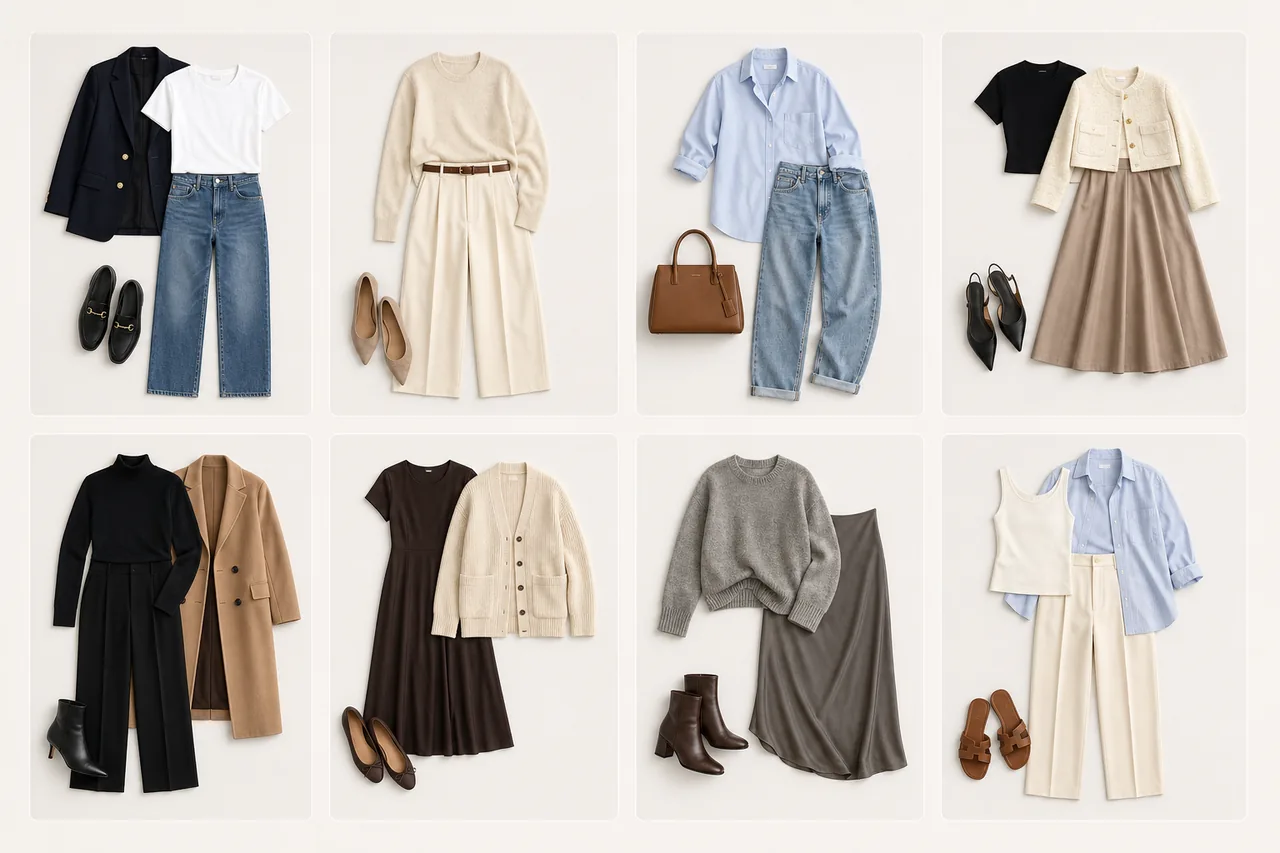
15 easy outfit formulas for women
| # | Outfit formula | Best for | Adjustment that changes the mood |
|---|---|---|---|
| 1 | White tee + straight jeans + blazer + loafer | Smart casual | Swap loafers for sneakers to relax it |
| 2 | Fine knit + wide-leg trouser + belt + streamlined shoe | Work or dinner | Tuck fully for polish or partially for ease |
| 3 | Button-down + relaxed denim + structured bag | Everyday | Roll sleeves and add a visible belt |
| 4 | Fitted top + midi skirt + short jacket | Balanced volume | Choose a pointed shoe for more length |
| 5 | Monochrome base + contrasting third layer | Fast polish | Echo the layer color once in an accessory |
| 6 | Simple dress + jacket + practical flat | One-step dressing | Change the jacket to shift the dress code |
| 7 | Knit + slip skirt + sneaker or boot | Texture contrast | Front-tuck the knit to restore shape |
| 8 | Tank + tailored trouser + open shirt | Warm weather | Match the tank and trouser for a longer line |
| 9 | Dark denim + knit + long coat | Cold casual days | Keep the shoe close to the denim color |
| 10 | Matching set + simple base + minimal shoe | Low-effort coordination | Split the set later for more combinations |
| 11 | Graphic or printed piece + two quiet neutrals | Statement dressing | Repeat one print color in the bag or shoe |
| 12 | Column of color + belt + textured layer | Elongated silhouette | Use the belt only when waist definition helps |
| 13 | Oversized top + slim or straight bottom + clean shoe | Relaxed proportion | Show wrist, ankle, or neckline for definition |
| 14 | Cropped top or jacket + high-rise bottom + low-volume shoe | Shorter vertical proportions | Keep the color break near the natural waist |
| 15 | Reliable base outfit + one evening swap | Desk to dinner | Change shoe, earring, or layer—not everything |
Five formulas worth saving first
Do not save all 15 at once. Start with the situations that repeat in your actual week.
1. The polished casual formula
Simple top + good denim + structured layer + clean shoe. This is the bridge between casual and intentional. The structure can come from a blazer, cropped jacket, cardigan with a firm edge, or an overshirt. Keep one element visibly relaxed so the outfit does not become officewear by accident.
2. The balanced-volume formula
Fitted or tucked top + fuller bottom + shorter layer. Use it with wide trousers, an A-line skirt, or relaxed jeans. The goal is not to hide or expose the body; it is to give the eye a clear change in volume. If both top and bottom are loose, reveal a small point of structure through the waist, wrist, ankle, or neckline.
3. The one-color column formula
Similar-color top and bottom + contrasting layer or accessory. A navy knit with dark denim, a cream top with stone trousers, or a black base under a camel coat creates one continuous line. The third piece adds depth and makes the formula look deliberate.
4. The one-piece formula
Dress or jumpsuit + defining layer + practical shoe + one finish. The one-piece item removes the hardest combination decision. The layer controls formality, the shoe controls reality, and the finish—earring, belt, scarf, or bag—prevents the result from looking unfinished.
5. The day-to-evening formula
Reliable daytime base + one high-impact swap. Build the day around a base that already fits well. For evening, change one or two details: sneaker to pointed flat, cardigan to blazer, tote to smaller bag, or stud to statement earring. A formula is strongest when it survives the day, not only the photo.
What is the 3-3-3 rule for clothes?
The 3-3-3 wardrobe rule is a small styling challenge: choose three tops, three bottoms, and three pairs of shoes, then create as many outfits as possible from those nine pieces. It is different from the three-color rule. The 3-3-3 rule tests versatility; the three-color rule simplifies the palette.
Use 3-3-3 to discover formulas. Photograph the combinations, reject the ones that only work in theory, and label the successful structures. You may find that “fine knit + wide trouser + loafer” works in four colors, while “oversized shirt + wide trouser + chunky sneaker” needs more proportion control.
How to adapt outfit formulas to your proportions
A formula should serve the effect you want, not assign your body a rulebook.
- For more waist definition: tuck, belt, crop the layer, or choose a clearer rise.
- For a longer visual line: reduce strong color breaks, repeat the shoe color, or use a column of color.
- For balanced volume: pair one fuller piece with one more defined area.
- For stronger shoulders: use a structured layer, sharper neckline, or visible collar.
- For a softer result: use drape, rounded shapes, lower contrast, or an open layer.
Change one variable at a time. If you change silhouette, color, shoe, and layer together, you will not know which adjustment improved the look.
Add color without breaking the formula
Keep the structural formula stable and change the palette separately. Start with one anchor neutral, one supporting color, and an optional accent. The clothing color combinations guide gives you 20 pairings and a visual hierarchy for doing this without making the outfit busy.
A 20-minute formula audit for your own closet
- Choose one repeated situation: office, errands, school run, dinner, travel, or weekend.
- Pull two reliable bottoms and three tops you genuinely wear.
- Add one layer and two realistic shoe options.
- Build three combinations and take full-length photos.
- Label the winning structure, not the brands: “fine knit + wide trouser + loafer.”
- Save one backup version for weather, laundry, or comfort.
This small audit creates more value than uploading an entire closet without a decision system. If you want a deeper owned-wardrobe workflow, continue with the outfit planner with your own clothes guide.
Use Beauty AI to improve and save the formula
Beauty AI works best as the feedback layer between “this should work” and “this actually works on me.” Upload version A and version B, then ask a focused question: Which has better proportion? Does the shoe feel too heavy? Does the layer create enough structure? Is the color contrast helping or distracting?
Once the formula works, save it with a situation label. The next time you have nothing to wear, you are not asking AI to invent a random costume. You are asking it to adapt a proven structure to weather, occasion, mood, or a different item. That is also why an AI stylist app is more useful than a feed of disconnected inspiration.
When an outfit formula stops helping
- It requires pieces you do not enjoy wearing.
- It solves a fantasy lifestyle instead of your calendar.
- It only works from one camera angle.
- It ignores weather, walking, sitting, or dress code.
- You repeat it without changing texture, color, or finish and start feeling bored.
Retire or revise the formula. A good wardrobe system changes with your body, work, climate, and taste.
FAQ
What is an outfit formula?
An outfit formula is a repeatable combination of clothing roles or silhouettes, such as fitted top + wide trouser + short layer + streamlined shoe. Exact colors and products can change while the structure stays useful.
What are some outfit formulas that always work?
Reliable starting points include white tee + straight jeans + blazer, fine knit + wide trouser + loafer, simple dress + jacket + flat, monochrome base + contrasting layer, and fitted top + midi skirt + short jacket.
Is the 3-3-3 fashion rule an outfit formula?
It is a challenge for discovering formulas. Three tops, three bottoms, and three shoes create a controlled mini-wardrobe. Photograph the successful combinations and name the repeated structures you want to use again.
How many outfit formulas do I need?
Most people get meaningful value from five to eight formulas tied to recurring situations. Start with your real week and add a formula only when it solves a repeated decision.
Can an app create outfits from my own clothes?
Yes. A wardrobe or AI stylist app can help organize clothing, compare combinations, and suggest changes. The best workflow begins with a draft from your real closet, uses AI for focused feedback, and saves the strongest formula for reuse.
Make good outfits repeatable
The point of easy outfit formulas for women is not to make everyone dress the same. It is to preserve what already works: the proportions, roles, and finishing choices that make a look feel right. Save five formulas for your real life, test two versions, and use the AI outfit maker in Beauty AI to improve the decision instead of starting over every morning.


