


Pear shaped body outfits can highlight your waist, add interest at the shoulders, follow your hips—or do none of those things if you prefer a relaxed line. Useful starting points include a square-neck top with straight jeans, an open shirt with comfortable trousers, and a wrap or A-line dress with practical shoes. The best choice depends on garment fit, movement and the effect you want, not a list of forbidden clothes. Below are 12 complete outfits, a fitting-room checklist and small adjustments you can compare using pieces you already own.
I’m David Voskanyan, founder and CTO of Beauty AI. I approach proportion advice as a way to compare clothing choices, not grade bodies. The examples here are styling suggestions; the illustrations are AI-generated, not evidence of measured fit or a body transformation.
Go straight to the 12 outfit ideas, fit checklist or one-change comparison.
What does a pear body shape mean for clothes?
“Pear” or “triangle” is a styling shorthand for hips that appear wider than the shoulders or upper torso. It does not specify your clothing size, height, bust size, waist definition or how you want to dress. Two people using the same label can need completely different rises, lengths and cuts.
You do not have to confirm a category before choosing an outfit. Start with what you notice in the clothes: a waistband that gaps, fabric that catches at the seat, a jacket hem you dislike, or a neckline you enjoy. Those are more actionable than trying to fit a whole person into a shape diagram.
There is no obligation to make shoulders and hips appear equal. If you like emphasizing your hips, keep the fitted skirt, bright trousers or skinny jeans. If you prefer more interest near the face, use a collar, a neckline or a textured top. These are different aesthetic choices, not a correct body and an incorrect one.
Choose the effect before choosing the garment
| Your goal | Try | What to compare |
|---|---|---|
| Show the waist | A comfortable tuck, shaped seam or shorter layer | Whether the waistband remains comfortable sitting down |
| Bring interest upward | An open collar, square neckline, earrings or textured knit | The whole look, rather than only a cropped torso photo |
| Keep a relaxed line | An open shirt, draped top or straight dress | Fabric movement and whether the length suits your preference |
| Follow the hips | A fitted skirt or jean with enough room to move | Pulling, riding up and comfort—not whether the outline is visible |
| Simplify the silhouette | Similar-color top and bottom with one distinct layer | Where the layer ends and how it behaves when you walk |
A belt cannot solve every fit issue. If the waist is loose but the seat is tight, pulling the belt harder may only gather fabric. Try a different cut, rise or size, or ask a tailor whether the garment can be altered without disrupting pockets and seams.
12 pear shaped body outfit ideas
1. Square-neck top, straight jeans and flats
Ivory square-neck top + straight blue jeans + cream flats. A more open neckline gives the upper half a clear shape while the jeans stay familiar. Choose a rise that remains comfortable when seated, not automatically the highest one. If the top is long, compare untucked and lightly tucked versions before replacing it with a cropped piece.
2. Open shirt, tank and wide-leg trousers
Blue shirt worn open + simple tank + navy wide-leg trousers + sneakers. This gives coverage without requiring a tightly defined waist. Let the shirt fall naturally and check it from the side as well as the front. If it catches at the hips, try a roomier shirt or a different length rather than treating your body as the problem.
3. Short jacket and everyday jeans
Plain tee + straight or slim jeans + short jacket + ankle boots. A jacket ending near the waistband creates a different outline from one ending lower on the hip. Neither is universally better. Keep the same jeans and shoes while you compare the jacket lengths; that makes the effect of the layer easier to see.
4. The work trouser outfit
Soft collared blouse + charcoal trousers + firm cardigan + loafers. Look for enough room at the thigh and seat before judging the waist. If pleats pull open or pockets flare, another cut may work better than hiding them under a longer top. Use a straight, wide or gently tapered leg according to your preferred silhouette.
5. A wrap dress for a warm day
Wrap or wrap-style midi dress + flat sandals + light bag. The adjustable waist can be useful, but check neckline security and skirt overlap while sitting and taking a long step. A fixed faux-wrap dress behaves differently from a tie-wrap. Choose the version that stays where you want it, without constant adjustment.
6. Knit top and A-line skirt
Fine knit + A-line midi skirt + simple flats. The skirt offers movement without requiring a loose top too. Wear the knit tucked, partly tucked or outside according to its thickness and your preference. If the waistband feels bulky, try a thinner base or leave the knit untucked; do not size down merely to make the tuck look smaller.
7. A fitted skirt on your own terms
Comfortable fitted skirt + boat-neck or crewneck top + low shoes. This deliberately follows the hips rather than disguising them. Check whether the skirt rides up when you walk and whether the waistband stays in place. A back or side slit can improve stride, but only if the fabric and construction suit the movement you need.
8. Warm-weather shorts and a cotton shirt
Relaxed-leg shorts + cotton shirt + sandals or sneakers. Choose the leg opening and length by comfort, not a rule that everyone with wider hips needs the same hem. Sit, climb a step and check for fabric catching. Wear the shirt open over a tank for a relaxed version or tuck it lightly for a more defined waist.
9. Cold-weather knit and bootcut jeans
Textured knit + bootcut jeans + boots + practical coat. Start with the footwear because the hem needs to clear it. A fine knit can replace a heavy sweater if your climate is mild. If the coat feels tight over layers, change the layering thickness or coat fit; a flattering photograph is not worth restricted movement.
10. The office-to-dinner switch
Navy trousers + soft blouse + blazer + loafers, then a smaller bag and different earrings. Keep the comfortable base and change the finish. A blazer with room through the seat can be worn long; a shorter one exposes more of the waistband. Compare both if you own them rather than assuming all jackets must end above the hips.
11. One-color base with a visible layer
Black or navy top + similar-color trousers + contrasting open jacket + comfortable shoes. The repeated base color makes the layer easy to evaluate. Use a soft cardigan if a structured jacket feels too formal. A pale trouser can work equally well: dark bottoms are an option for a quiet contrast, not a requirement for a pear shape.
12. The weekend outfit with skinny jeans
Your favorite skinny jeans + a tee + relaxed overshirt + sneakers. Keep this if you like the close-fitting lower half. Try the overshirt open, closed or removed and choose the outline you enjoy. The relevant checks are waistband comfort, knee movement and whether the pieces work together—not whether a shape guide gives permission.
For more repeatable combinations beyond one proportion label, use the easy outfit formulas for women. A formula is useful when it survives substitutions from your real wardrobe.
Same base outfit, one change at a time
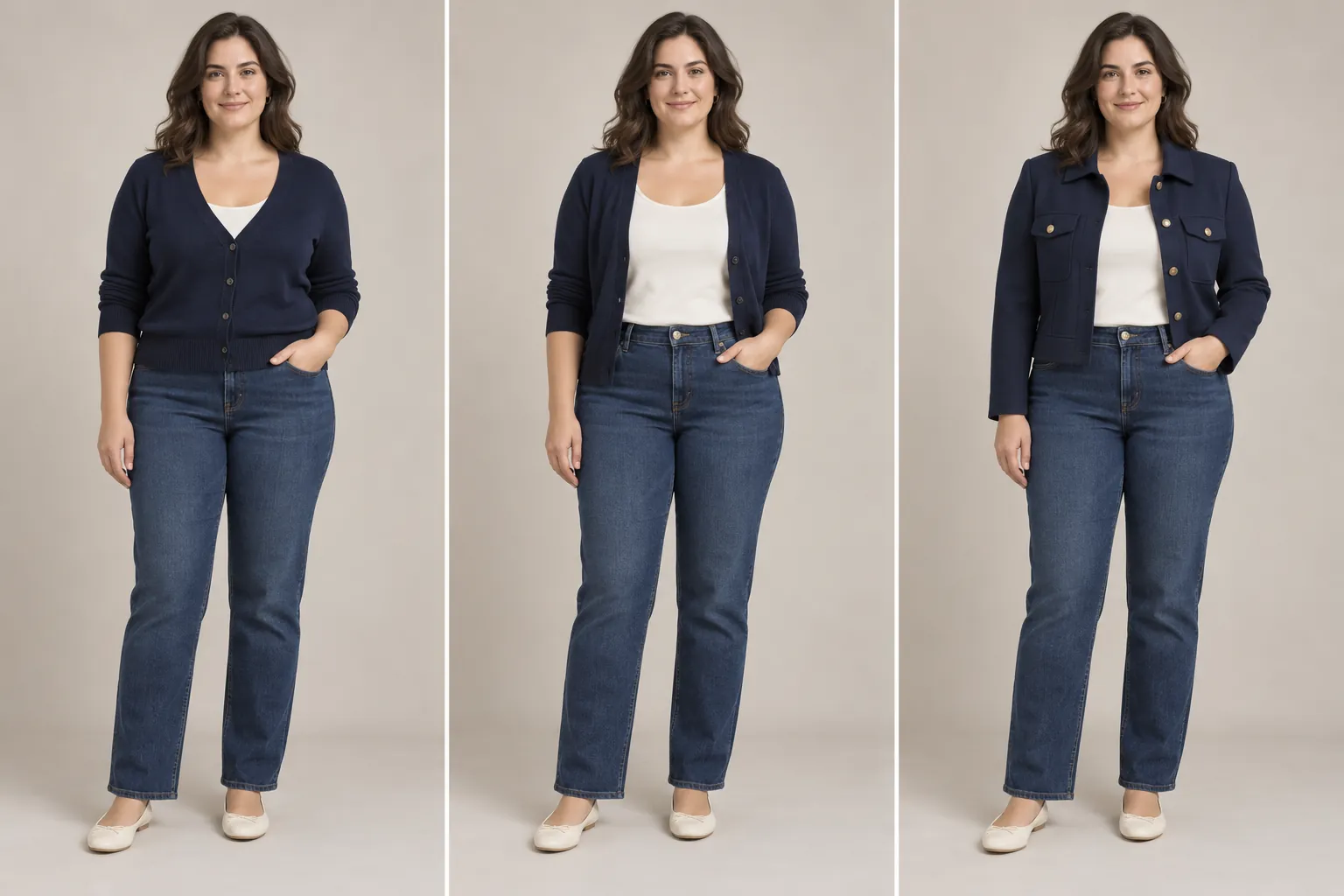
Use a base you already trust: jeans, a plain top and everyday shoes. In version A, wear your usual layer. In version B, open the layer and try a small tuck if comfortable. In version C, change only the outer layer. Notice where the eye pauses and whether the outfit feels easier to wear.
Do not change the camera angle, pose, top, jeans and lighting all at once and then attribute the result to one hem. The illustration above explains the idea; your own consistent photos and movement checks are more useful for choosing an actual garment.
If color is the variable you want to compare, keep the silhouette fixed. The clothing color combinations guide gives alternatives beyond the usual light-top, dark-bottom suggestion.
A fitting-room checklist for jeans, trousers and dresses
- Fit the fullest area without forcing it. Check the seat and thighs, then the waist. Sizing labels vary; “curvy fit” is a cut description, not a universal guarantee.
- Sit and stand normally. Notice pressure, digging, sliding and pulling. Do not hold a pose to make the garment appear comfortable.
- Walk and reach. Watch whether a skirt climbs, a wrap opens, a shirt catches or a jacket pulls across the back.
- Use the intended shoes. Check the trouser hem and the overall outline with the footwear you will actually wear.
- Inspect in ordinary light. Look at opacity, lining and seam behavior. A dark fitting room can hide details you notice immediately outside.
- Separate alteration from replacement. A modest waist adjustment may be feasible, but moving pockets, zips or complex seams is a different job. Ask before buying a garment that needs major changes.
Before rejecting a cut, try another brand or construction if available. Straight jeans can have very different waist-to-hip shaping; stretch can help movement but does not automatically correct the rise or waistband. If an item only works while standing still, it is not yet a reliable everyday outfit.
Petite, tall and plus-size: adjust the pattern, not the person
Petite: compare where the garment’s waist seam and knee shaping sit, not just total length. A hem can sometimes be shortened, but that does not relocate every proportion in the pattern. Full-length wide trousers are still an option when the rise, shoe clearance and movement work.
Tall: check torso length, sleeve length and where a cropped layer ends on you. A dress described as midi may land differently; use the actual garment rather than the label. The same applies to a supposedly high-rise jean.
Plus-size: look for enough room where you need it while keeping the shoulder and waist construction comfortable. Extra fabric everywhere is not the only route to coverage. Fitted, draped and structured outfits can all work; size availability and garment construction often matter more than a body-shape rule.
Use an outfit photo to ask a better styling question
In Beauty AI, upload an outfit photo with the shoes and outer layer visible, then describe the change you want. For example: “I like these jeans and do not want to hide my hips. Compare this open cardigan with my shorter navy jacket for a casual dinner. Keep the shoes and suggest no purchases.”
Another useful question is: “I want more waist definition without a tight belt. What can I change using this shirt and these trousers?” Review any answer against the real fabric and your comfort. AI can suggest combinations and explain a visible outline; it cannot establish accurate measurements, physical fit or the right clothing size from an outfit image.
If you are choosing a tool rather than a look, the body shape apps comparison separates calculators, style profiles and outfit advice. For a restrained wardrobe direction you can combine with these adjustments, see the old money outfit ideas.
Compare one outfit in Beauty AI with a specific goal. Keep the version you like wearing, even when it ignores a supposed rule for your shape.


