

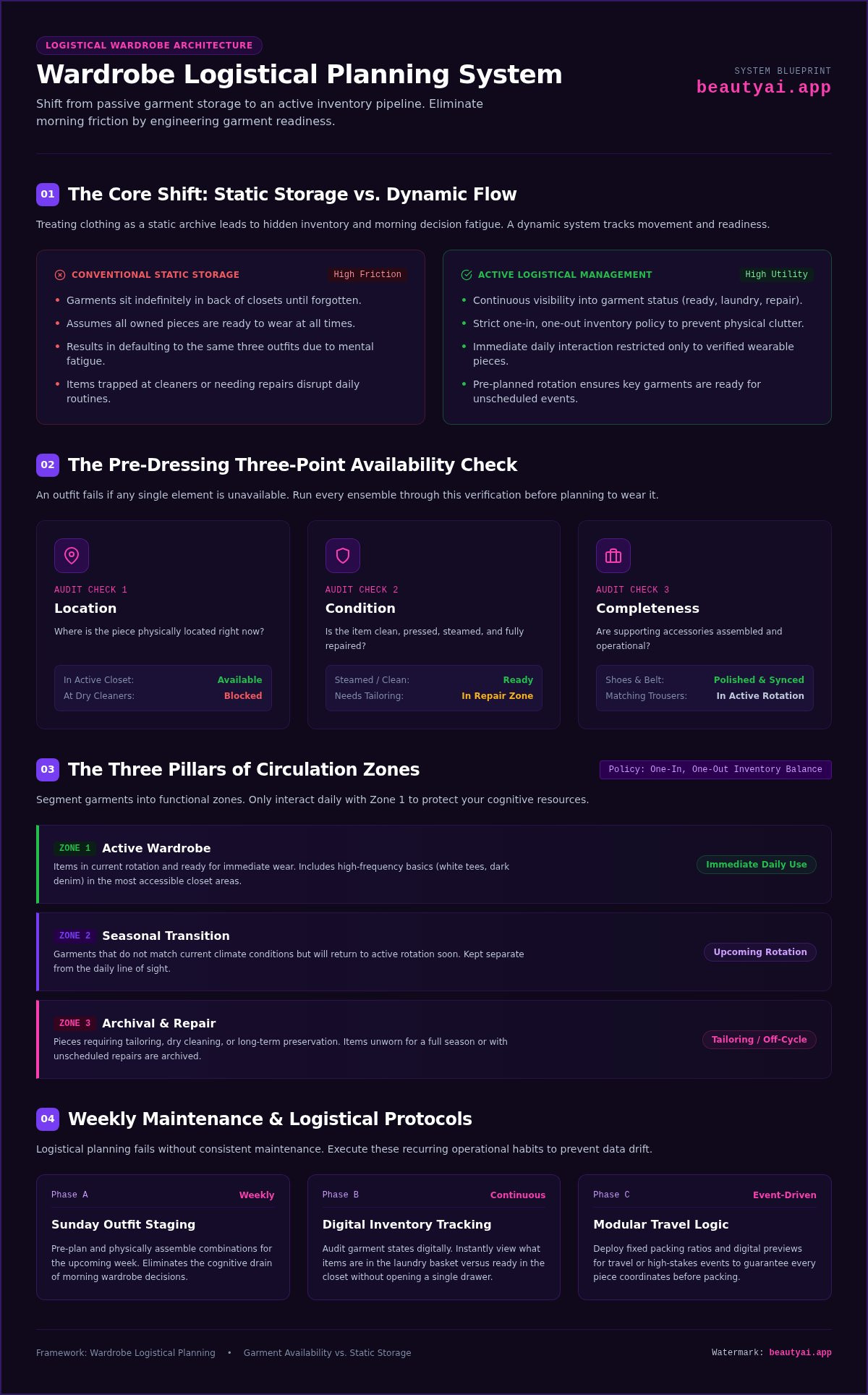
Why does a closet full of quality garments often result in the frustrating feeling that you have nothing to wear? This friction occurs because your clothes aren't where you need them when you need them. To eliminate this, adopt a system for wardrobe logistical planning that prioritizes garment readiness over mere storage. Before dressing, use this three-point availability check:
- Location: Is the item in your active closet or still at the cleaners?
- Condition: Is the garment clean, pressed, and free of necessary repairs?
- Completeness: Are the supporting accessories, like a specific belt or polished shoes, ready for use?
Key Takeaways
- Shift your perspective from static storage to a dynamic system that manages garment availability. Effective wardrobe logistical planning ensures that your clothes are always ready for immediate use rather than lost in the back of a closet.
- Organize your collection into functional zones to separate active daily items from seasonal archives. This structure reduces mental clutter and makes it easier to track which pieces need maintenance or repair.
- Establish a weekly maintenance routine that includes Sunday outfit staging and digital inventory updates. Pre-planning your looks for the week ahead eliminates morning decision fatigue and identifies gaps in your rotation.
- Apply modular logic to travel and high-stakes events by using digital previews and specific packing ratios. This approach ensures every combination works together before you even open your suitcase.
Table of Contents
Understanding the Fundamentals of Wardrobe Logistical Planning
Wardrobe logistical planning is the systematic management of garment availability. It's the difference between simply owning clothes and being able to wear them. Most people treat their closets as static storage, a physical archive where items sit until they're remembered. A dynamic system treats clothing as active inventory that moves through various stages: ready to wear, in the laundry, or requiring repair. This shift in perspective turns your closet into a high-performance utility.
Many individuals utilize a capsule wardrobe system to reduce sheer volume. While this simplifies choices, logistical planning manages the actual flow of those pieces. High inventory visibility eliminates the daily friction of searching. If you can't see a garment, you won't wear it. Move away from reactive dressing and adopt a proactive, data-informed approach. This ensures your tailored charcoal blazer isn't trapped in a laundry basket when you have an unscheduled client meeting.
Identifying Friction Points in Your Morning Routine
Audit the time you spend looking for specific items versus actually putting them on. Friction often stems from hidden inventory. When garments are buried in storage or lost in the back of a drawer, decision fatigue sets in. You likely default to the same three outfits because they're the only ones you can find quickly. This mental load is a direct result of poor organization and lack of visual access.
Transition from physical guesswork to a structured overview. Learn how to build a digital wardrobe to establish a baseline for your collection. This initial setup provides the clarity needed to manage your clothing lifecycle effectively. By digitizing your options, you remove the physical barriers that lead to morning stress and wasted time. You'll gain a clear view of your entire inventory at all times, making every purchase work harder for you.
The Three Pillars of an Efficient Clothing Lifecycle
Wardrobe logistical planning relies on three distinct zones of circulation. Most people fail because they treat every item in their closet as if it's currently wearable. By segmenting your inventory, you create a system where you only interact with ready-to-use garments. This reduces decision fatigue by narrowing your focus to viable choices. It's a method that prioritizes daily functionality over mere possession.
- Zone 1: Active Wardrobe. These are items currently in rotation and ready for immediate daily use.
- Zone 2: Seasonal Transition. Garments that don't match the current weather but will return to rotation soon.
- Zone 3: Archival/Repair. Items needing tailoring, cleaning, or long-term storage.
Maintain logistical balance by enforcing a one-in, one-out policy. When you purchase a new navy sweater, an existing piece must move to the archival zone or leave the system entirely. This prevents the physical and mental clutter that stalls efficient mornings. It keeps your inventory lean and high-performing. You'll find that a smaller, well-managed rotation is more useful than a massive, unorganized collection.
Categorizing Garments by Utility and Frequency
Separate your high-frequency basics from occasion-specific statement pieces. Basics like white tees or dark denim should live in the most accessible part of Zone 1. Use a digital wardrobe app to track the status of each item. This allows you to see what's in the laundry versus what's ready to wear without opening a single drawer.
Set clear rules for when an item moves to the archival zone. If a garment hasn't been worn in a full season or requires repairs you haven't scheduled, it's no longer active. Moving these pieces out of your daily sightline clears the path for faster decisions. This keeps your active closet focused on items that genuinely serve your current lifestyle.
Implementing a Weekly Routine for Wardrobe Maintenance
Consistency is the engine of any logistical system. Without a recurring maintenance cycle, your wardrobe logistical planning will eventually fail due to outdated data. Dedicate specific time blocks each week to audit your inventory and prepare for upcoming demands. This transition from chaos to control requires a deliberate four-step cycle.
Stage your outfits every Sunday night by selecting five primary looks based on your professional and social schedule. This removes the morning scramble and ensures your clothes are physically accessible. Update your records immediately after laundry to ensure items previously marked as "cleaning" are returned to active status. During this process, consult the FTC's Care Labeling Rule guidelines to verify you're using correct cleaning methods for specific fibers. This prevents permanent damage to high-value items like silk blouses or linen suits, extending their lifespan within your rotation.
Using a Digital Closet for Inventory Maintenance
Digitize new acquisitions immediately to keep your system accurate. If you purchase a pair of tan loafers, photograph them before they enter your storage. This ensures your digital view matches your physical reality at all times. Maintaining this data integrity allows you to make informed decisions about what to wear without physically rummaging through drawers.
Track your cost-per-wear to identify logistical dead stock—items that consume physical space but offer zero utility. You can also leverage virtual try-on tools to test new combinations without physical effort. For example, you might see how a vintage leather jacket pairs with modern wide-leg trousers in seconds. This digital staging prevents you from discovering a styling clash when you're already running late, ensuring every piece in your active zone is ready for immediate use.
Strategic Planning for Travel and High-Stakes Events
Travel and high-stakes events represent the ultimate test of your wardrobe logistical planning. When you're away from your home inventory, you can't rely on last-minute laundry or a deep closet of backups. You must treat your suitcase as a closed-loop system where every item earns its place through versatility. Efficiency is mandatory here. Major U.S. domestic carriers like American, Delta, and United now strictly enforce a carry-on size standard of 22 x 14 x 9 inches. Many gates utilize automated digital luggage scanners, so overpacking isn't just a nuisance; it's a logistical failure that leads to unexpected fees.
Apply modular packing logic to maximize utility. A reliable ratio is one bottom for every three tops. For a short trip, two pairs of trousers and six tops provide eighteen potential combinations. Prepare event-specific kits for weddings or conferences. Include all necessary accessories, footwear, and undergarments in a single digital preview. This ensures you don't arrive at a formal engagement only to realize your specific dress shoes or accessories are still on your dresser. Digital visibility prevents these high-friction errors.
Developing a Modular Packing Strategy
Create a dedicated collection within your capsule wardrobe app to isolate your travel pieces. This digital staging area allows you to visualize how items interact before they touch your luggage. Validate your choices by reviewing AI style feedback for color balance and occasion fit. It's a faster way to confirm that your navy blazer works with both your chinos and your dark denim.
Schedule your outfits in advance using your virtual closet app. Mapping specific looks to your itinerary prevents the common mistake of packing "just in case" items that never leave the bag. By aligning your digital plan with the local weather and your social schedule, you ensure maximum utility from a minimal footprint. This structured approach transforms travel from a source of stress into a seamless extension of your daily routine.
Master Your Daily Inventory Flow
Efficient dressing is a result of intentional organization rather than lucky impulses. By implementing a system for wardrobe logistical planning, you replace morning friction with a predictable, high-performance routine. You've learned how to segment your collection into functional zones and maintain visibility through weekly audits. These habits ensure that every garment you own is ready for immediate circulation, whether you're heading to the office or packing for a high-stakes trip.
Technology simplifies this transition from abstract inspiration to concrete management. You can leverage AI-driven style feedback and virtual try-on visualizations to test combinations without physical effort. With cross-platform sync for both iOS and Android, your inventory data is always accessible. Take the final step toward a frictionless morning. Download Beauty AI to start your wardrobe logistical planning today. It's time to treat your personal style as a skill you've mastered through discipline and better tools. You're now equipped to move through your day with total confidence and calm efficiency.
Frequently Asked Questions
What is the first step in wardrobe logistical planning?
The first step is digitizing your current collection to gain total inventory visibility. You can't manage what you can't see. Start by photographing your most frequently worn items, such as your favorite navy blazer or dark denim. This creates a baseline for your wardrobe logistical planning and allows you to track item readiness. Once your core pieces are logged, you can begin categorizing them into active and archival zones.
How often should I audit my digital wardrobe inventory?
Perform a quick status check weekly and a comprehensive audit once per season. A weekly review, ideally on Sunday evenings, ensures your digital records match physical reality after laundry cycles. Use this time to move items between "active" and "cleaning" status. Seasonal audits allow you to rotate heavier coats or summer linens into storage. This keeps your primary view focused only on garments that are currently wearable.
Can an app really help with physical wardrobe logistics?
A digital tool acts as the central hub for your clothing data and movement. While it doesn't physically move your hangers, it tracks which garments are available, in repair, or at the cleaners. Apps like Beauty AI provide virtual try-on features and AI-driven style feedback. These tools help you plan combinations without making a physical mess of your closet. This visibility reduces the mental load of garment tracking significantly.
How do I manage seasonal clothes that are in storage?
Use the "Archival" zone in your digital closet to track items stored in bins or trunks. This keeps your main feed clear while ensuring you don't forget about your winter wools or summer swimwear. When the weather shifts, you can virtually browse your storage to decide which pieces to bring back into circulation. This prevents you from buying duplicates of items you already own but can't see.
What is the most common mistake in wardrobe planning?
The most common mistake is failing to account for the "maintenance queue" in your daily routine. Many people plan outfits without checking if the specific pieces are clean or in good repair. If your tailored trousers are at the tailor or your white shirt has a stain, your plan fails. Successful wardrobe logistical planning requires tracking the readiness of every garment. This ensures you never face a last-minute emergency.


