


Apple shaped body outfits can start with clothes that feel good to sit, walk and reach in—not a list of pieces you are forbidden to wear. Many people who use this label like a soft open layer, an open neckline, a smooth waistband or a dress that moves easily. Others prefer a close-fitting top, a belt or a short jacket. The useful question is the effect you want and whether the garment works on your body in motion. Below are 10 complete outfits, a quick fit checklist and small changes to try with clothes you already own.
I’m David Voskanyan, founder and CTO of Beauty AI. This is a practical styling guide, not a medical assessment or a rulebook for bodies. “Apple” is only a visual shorthand; it does not determine your size, health, shape on every day, or what you are allowed to wear.
Jump to the 10 outfit ideas, the fit checks, or the one-change comparison.
What does “apple shaped” mean in styling?
People commonly use “apple” when their upper torso or midsection appears fuller relative to their hips. That description is broad. It cannot tell you how a waistband, sleeve, bust dart or hem will fit, and many people see a mix of proportions. Use the label only if it gives you useful ideas; start with a real garment problem instead—pressure while seated, a jacket that pulls, or a length you do not enjoy.
You do not need to minimize any part of yourself. If you like a defined waist, test a tie or shaped seam. If you prefer an easy, continuous line, try a fluid shirt or open layer. The aim is an outfit that feels intentional and usable.
Choose an effect before choosing a garment
| Your preference | Try | Check in real life |
|---|---|---|
| A longer visual line | Open collar, V or scoop neckline, open layer | Whether the layer catches when you sit or reach |
| A defined waist | Wrap, shaped seam, tie placed where comfortable | Whether it stays comfortable after a meal and while seated |
| An easy, relaxed line | Fluid shirt, straight dress or soft cardigan | Fabric movement instead of a posed mirror image |
| More structure | Blazer, overshirt or coat with shoulder room | Back, arm and button tension |
| A statement lower half | Wide-leg trouser, skirt, color or texture you enjoy | Waistband stability and stride |
10 apple shaped body outfit ideas
1. Open-collar shirt, straight trousers and loafers
Soft open-collar shirt + straight navy trousers + loafers. This is a calm work formula that does not require a tight tuck. Try the shirt untucked, a half-tuck or fully tucked only if the waistband remains comfortable. Check the shirt while seated: button pull and hem movement matter more than a front-facing pose.
2. Fine knit, relaxed jeans and an open overshirt
Fine knit + relaxed straight jeans + open cotton overshirt + sneakers. The overshirt is optional structure, not camouflage. Compare it open, buttoned and removed. Keep the version that lets you move your arms and makes the outfit feel like you, even if it breaks a generic style rule.
3. Wrap or faux-wrap midi dress
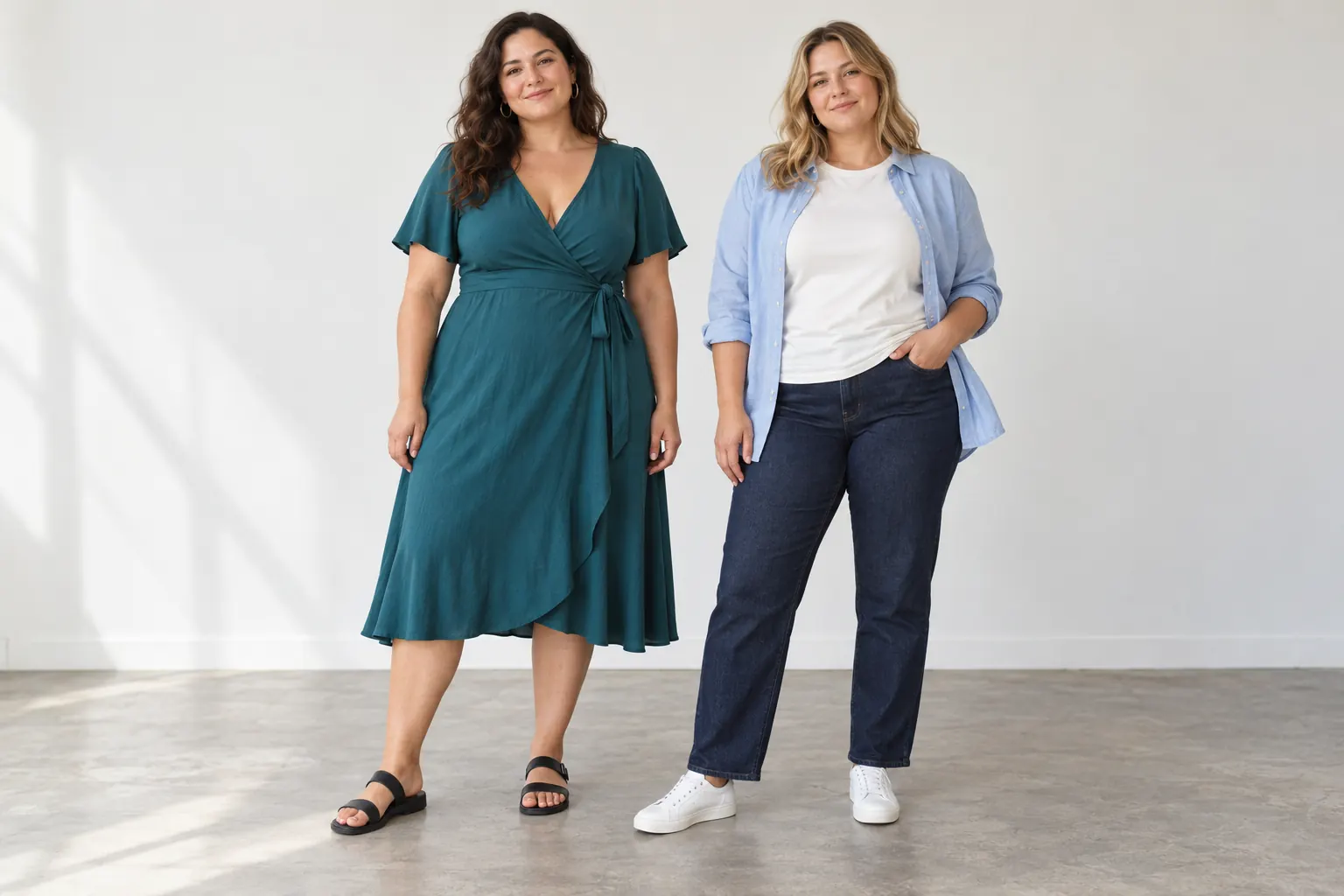
Wrap-style midi dress + flat boots or sandals. A diagonal line and adjustable tie can be useful, but test the neckline, overlap and tie position during a long step and while sitting. A faux-wrap may stay put better for some people; a real wrap offers more adjustment for others.
4. T-shirt, wide-leg trousers and a short jacket
Plain tee + fluid wide-leg trousers + short jacket + low shoes. A shorter layer changes the visible waistband; a longer jacket creates a different line. Neither is automatically better. Use the same tee and trousers to compare lengths, then choose by comfort and the proportion you prefer.
5. Soft blazer, tank and dark denim
Tank or shell + dark straight denim + unbuttoned soft blazer + clean trainers. The useful fit test is at the shoulders and across the upper back. If a blazer restricts driving or reaching, try a roomier cut or a knit jacket rather than forcing the buttons closed.
6. Column base with a long cardigan
Similar-color top and trousers + long cardigan + boots. A near-monochrome base makes it easy to judge the cardigan’s length without changing every other variable. Choose a fabric that moves with you; a long layer should not become something you constantly hold aside.
7. Shirt dress with practical shoes
Shirt dress + belt only if wanted + loafers or boots. Wear it loose for an easy line, or tie it where you enjoy the shape. Check the button spacing when seated and the skirt when walking stairs. An optional belt is a styling choice, not a repair for poor fit.
8. Knit top, A-line skirt and a light jacket
Fine knit + A-line or bias midi skirt + light jacket + flats. Start with the waistband: it should lie comfortably without rolling or digging. If the knit feels bulky when tucked, test a thinner top or leave it out; do not reduce a size just to force a silhouette.
9. Weekend shorts and a linen shirt
Relaxed shorts + linen shirt + sandals or sneakers. Test the leg opening by sitting and taking a step. Wear the shirt open over a tank for an airy look or button it partly for more coverage. Hem preference is personal; there is no universal “best” length.
10. Event-ready draped dress and open coat
Fluid draped midi dress + open lightweight coat + comfortable dress shoes. Let the dress and coat move together before choosing accessories. The coat can stay open for a vertical line, but close it if the weather or venue requires it. A polished outfit is still allowed to be warm and easy to walk in.
Compare one change at a time
Pick a base you already wear: trousers or jeans, a top and everyday shoes. First compare an open layer with no layer. Next, if you own one, swap only the layer length. Keep the camera height, pose, shoes and lighting consistent. This makes it easier to notice the actual difference instead of crediting a new angle or different posture.
Ask three questions: Do I feel able to sit and reach? Do I like where the eye lands? Would I wear this for the duration of the occasion? Your answer matters more than whether a guide calls the outline “flattering.”
Fit checks before you keep an outfit
- Sit down normally. Notice digging, rolling, button pull, wrap opening or a hem that rides up.
- Walk and take a full step. Check skirt overlap, trouser stride and whether the layer catches.
- Raise your arms and turn. Shoulder room and back tension are often missed in a mirror photo.
- Use the actual shoes. Shoe height changes trouser hem, balance and how long you can stand.
- Inspect in normal light. Check opacity, lining and whether a seam twists or a fabric clings.
- Separate tailoring from a bad starting fit. A modest waist adjustment can help; a garment that pulls in several places may need another cut.
Petite, tall and plus-size: adjust the garment, not the person
Petite: look at where a waist seam, knee shaping and jacket hem land, not only the listed length. Tall: check torso and sleeve length and whether “midi” lands where you want it. Plus-size: prioritize room where you need it, reliable fabric and comfortable construction; fitted, draped and structured clothes can all be valid choices. A body-shape label never replaces trying the actual garment in motion.
Use an outfit photo for a specific question
Beauty AI can be helpful once you choose the outfit and the decision. Try: “I want to keep these trousers and shoes. Compare my open cardigan with this short jacket for an all-day work event. I want comfort while sitting and no shopping suggestions.” Review any response against the real garment and your comfort.
It cannot measure your body, confirm a body-shape label, determine size or guarantee physical fit from a photo. For the broader tool-selection task, see the body shape apps comparison. For another proportion-specific set of practical examples, see pear shaped body outfits and inverted triangle outfit ideas.
Open Beauty AI when you want to compare a real outfit with a clear goal. Keep the version you enjoy wearing—even when it ignores a supposed rule.
FAQ
What clothes suit an apple shaped body?
There is no required uniform. Open necklines, fluid layers, straight or wide-leg trousers, wraps and softly shaped dresses are common starting points. Test the specific garment for comfort and the effect you want.
Do I need to avoid high-rise trousers or belts?
No. Try them if you like them. The relevant test is whether the waistband or belt stays comfortable when seated and moving; rise and belt placement vary a lot by garment.
Is “apple shape” a diagnosis?
No. It is a styling label people use to describe a visual proportion. It says nothing medical and is not a reason to restrict what you wear.
Can an app tell me my body shape or size?
Do not rely on an outfit photo for a definitive shape, measurement or size. Use tools for ideas and compare them with real garment fit and your own judgment.
Bottom line
The best apple shaped body outfits are the ones that support the effect you want and remain comfortable in real movement. Start with a familiar base, change one neckline, layer or waistband at a time, and keep the combinations you will actually repeat.


