

An office outfit planner app should do more than show attractive office outfit ideas. The real value is turning Monday to Friday into a set of wearable decisions before the week starts. That means matching outfits to meetings, commute, weather, dress code, laundry, comfort, and repeat avoidance from the clothes you already own.
Most search results for work outfits are strong at inspiration and shopping. They usually explain business casual through blazers, trousers, dresses, cardigans, loafers, and polished layers. That is useful, but it does not answer the harder question: "What should I wear to work this week without buying five new things?" This guide gives you a practical office planning system you can reuse.
What an office outfit planner app needs to solve
A generic outfit app can help you make combinations. A strong work outfit app has to solve a narrower problem: you need to look appropriate at 9 a.m., stay comfortable at 2 p.m., and still feel intentional if the day changes. That is why office planning needs more context than casual styling.
| Planning problem | Why it matters at work | What the app should help you decide |
|---|---|---|
| Dress code | The same outfit can be smart in one office and too casual in another. | Whether the look is corporate, business casual, smart casual, or too relaxed. |
| Calendar pressure | A presentation day needs more polish than a quiet admin day. | Which outfit should be saved for visibility, meetings, or client contact. |
| Repeat avoidance | Repeating is fine, but repeating the same visual formula too closely can feel unplanned. | How to rotate base pieces, layers, colors, and shoes across the week. |
| Comfort and commute | Office outfits fail when shoes, fabric, or layers do not survive the real day. | Which version is wearable for walking, transit, air conditioning, heat, or long sitting. |
| Backup planning | Laundry, weather, and surprise meetings break weak outfit plans. | One fallback outfit that keeps the same level of polish. |
This is the content gap most app listings and fashion idea pages leave open. They explain features or show outfits, but they rarely connect the weekly office calendar to your actual closet.
The 5-day workwear rotation
The easiest way to use a work outfit planner is to assign each day a job. Instead of building five unrelated looks, plan a weekly rotation with a reason behind each outfit.
- Monday polished: start the week with your most reliable professional base.
- Tuesday meeting-ready: reserve your sharpest layer, shoe, or dress formula for higher visibility.
- Wednesday comfortable: choose fabrics and shoes that survive a long desk day.
- Thursday desk-to-dinner: use a base that can shift from office to evening with one swap.
- Friday casual but intentional: dress down without looking accidental.
This is where a planner beats a mood board. A mood board gives you ideas. A planner gives each idea a calendar role.
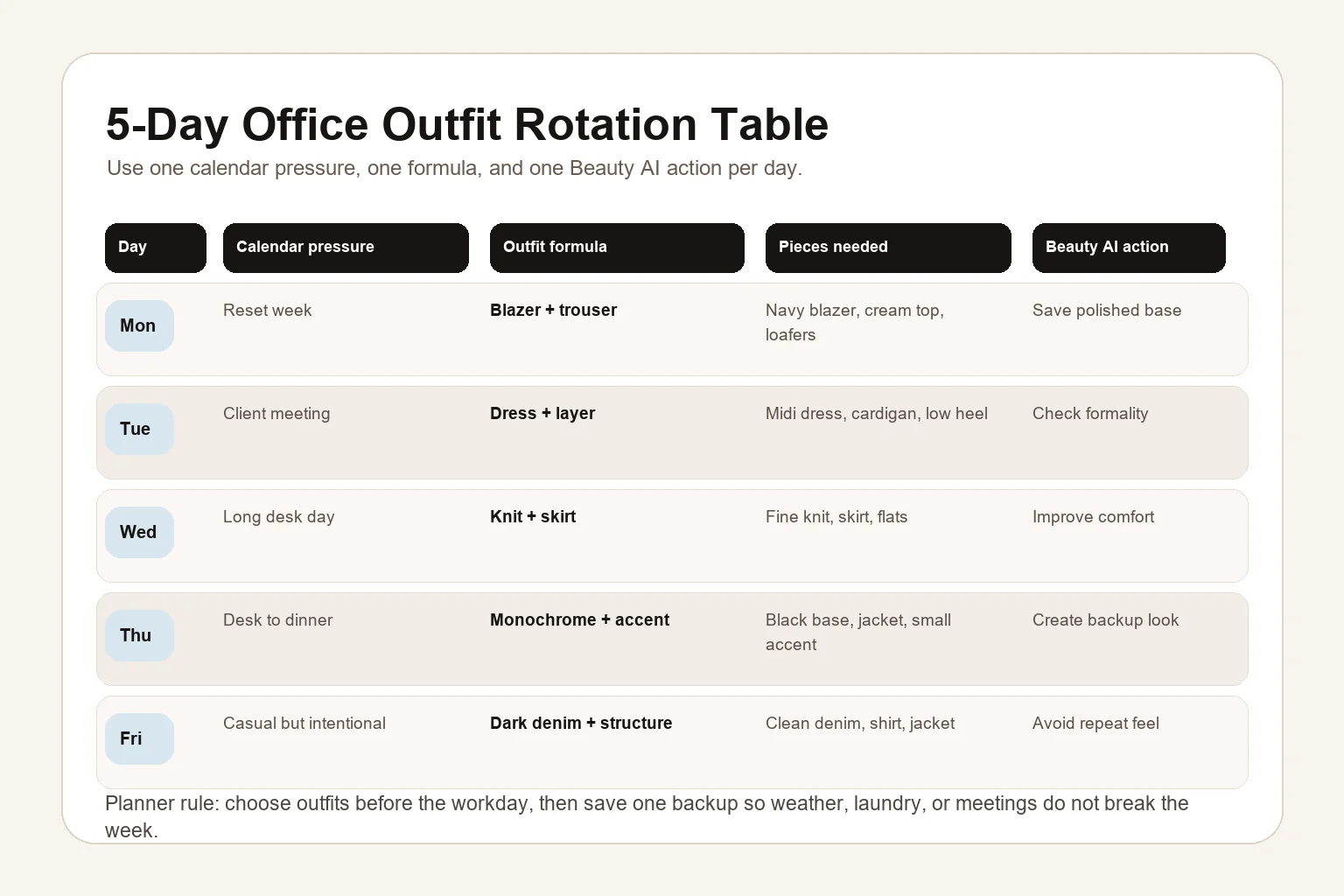
5-Day Office Outfit Rotation Table
| Day | Calendar pressure | Outfit formula | Pieces needed | Beauty AI action |
|---|---|---|---|---|
| Monday | Reset the week and look pulled together | Blazer + trouser + simple top | Navy blazer, cream knit, tailored trouser, loafer | Save as your polished base look |
| Tuesday | Client call, presentation, or manager meeting | Dress + structured layer | Midi dress, cardigan or blazer, low heel or flat | Check formality and camera contrast |
| Wednesday | Long desk day with less visibility | Fine knit + skirt or relaxed trouser | Soft knit, midi skirt, belt, flats | Improve comfort without losing polish |
| Thursday | Office to dinner, networking, or after-work plans | Monochrome base + accent layer | Black base, jacket, earring, cleaner shoe | Create one evening-ready backup |
| Friday | Casual office day | Dark denim + structured jacket | Dark jean, button-down, jacket, clean shoe | Check that the outfit still feels intentional |
Office dress code matrix
Before building outfits, define the office lane. A good planner should not treat every workplace as the same. Use this matrix to keep your weekly rotation realistic.
| Workplace type | Best outfit base | Strong shoe choice | Risk to avoid |
|---|---|---|---|
| Corporate or client-facing | Tailored trouser, blazer, dress, button-down, structured knit | Loafer, pump, flat, polished boot | Unstructured denim, thin tees, loud trend pieces, casual sneakers |
| Business casual | Trouser, midi skirt, cardigan, knit, blazer, clean dark denim if allowed | Loafer, flat, ankle boot, low heel, minimal clean shoe | Looking too weekend, too wrinkled, or too unfinished |
| Creative office | Simple base with stronger color, texture, print, or silhouette | Loafer, boot, refined sneaker, statement flat | Too many statement pieces competing in one outfit |
| Hybrid or video-call heavy | Structured top, clean neckline, camera-friendly color, comfortable bottom | Any shoe that works if you need to leave the house | Only styling the top half and getting caught by a sudden commute |
| Casual office | Dark denim, clean tee or knit, overshirt, cardigan, casual jacket | Clean sneaker, loafer, boot, simple flat | Looking like you forgot you were going to work |
Business casual rules that matter in real offices
A business casual outfit planner is not trying to make every look formal. It is trying to keep comfort and authority in balance. That balance usually comes from five practical rules.
- Fit beats novelty. A plain trouser that fits well usually looks more professional than a trend piece that pulls, wrinkles, or sits wrong.
- Shoes set the office signal. Loafers, flats, ankle boots, low heels, and clean minimal shoes can make simple pieces feel work-ready.
- Fabric controls polish. Thin, clingy, shiny, or overly wrinkled fabrics make business casual look accidental.
- One layer does a lot. A blazer, cardigan, vest, trench, or structured jacket can turn casual pieces into office outfits.
- Trend should be the accent, not the system. Keep the base repeatable, then add one current detail if your workplace allows it.
For business casual outfits for women, the same logic usually appears through blazers, midi skirts, dresses, cardigans, tailored trousers, and polished flats. For men, it often appears through chinos, clean denim in relaxed offices, button-downs, knits, loafers, and unstructured jackets. The planner logic is the same: build outfits around the workday, not just the item.
Business casual pressure levels
The phrase "business casual" is too broad unless you attach it to the day. A weekly planner should let you choose a pressure level first, then build the outfit around that level.
| Pressure level | Use it for | Outfit target | Fast test |
|---|---|---|---|
| Level 1: relaxed office | Internal desk work, low visibility, casual Friday | Clean, comfortable, still deliberate | If you removed one layer, would it still look like work? |
| Level 2: standard business casual | Normal office days, team meetings, hybrid days | Polished base plus one soft or casual element | Would this feel normal beside a manager or senior teammate? |
| Level 3: meeting-ready | Client calls, interviews, presentations, reviews | Structured, tidy, low-distraction, camera-safe | Would this look intentional in a screenshot or group photo? |
Work outfit formulas you can repeat
Repeatable formulas are stronger than one-off inspiration because they turn your closet into a system. Use these as starting points, then save the versions that work in your digital wardrobe app.
| Formula | Best for | Why it works |
|---|---|---|
| Blazer + trouser + simple top | Monday, meetings, office visibility | It creates structure quickly and works across many dress codes. |
| Knit + skirt + flat | Comfortable business casual | It softens the outfit while keeping a deliberate silhouette. |
| Dark denim + structured jacket | Casual Friday or relaxed offices | The jacket prevents denim from reading too casual. |
| Dress + cardigan or blazer | Fast mornings and presentations | The dress reduces decisions, and the layer adjusts the formality. |
| Monochrome base + one accent | Desk-to-dinner days | The base stays clean, while the accent adds personality without clutter. |
Work outfit ideas by real office scenario
Searches for "office outfit ideas" usually return looks without context. In real life, the context is the outfit brief. Start with the scenario, then choose the formula.
| Scenario | Best formula | Planner note |
|---|---|---|
| Big meeting at 10 a.m. | Blazer + trouser + calm top + polished shoe | Choose the outfit the night before and avoid experimental pieces. |
| Long focus day | Knit + relaxed trouser + flat or clean sneaker | Keep the look comfortable but add a structured layer nearby. |
| Video calls all afternoon | Camera-friendly top + simple layer + neat neckline | Check color contrast against your background and lighting. |
| After-work dinner | Monochrome base + sharper shoe + small accent | Save one swap: shoe, jacket, earring, belt, or bag. |
| Rainy commute | Dark trouser + knit + weather-safe shoe + trench or jacket | Avoid hems and shoes that fail before you reach the office. |
| Casual Friday | Dark denim + button-down + jacket | Denim works best when the rest of the outfit is more structured. |
Turn 10 core pieces into 15 office outfits
You do not need a huge work wardrobe to look consistent. You need a small set of pieces that combine cleanly. A strong starter set can be:
- navy blazer
- neutral cardigan
- white or cream button-down
- fine knit top
- tailored black trouser
- navy or gray trouser
- midi skirt
- simple work dress
- dark clean denim if your office allows it
- one polished shoe you can wear all day
From those 10 pieces, you can build at least 15 office outfit ideas without changing your whole wardrobe.
| Base piece | Three office outfits |
|---|---|
| Tailored trouser | With blazer and button-down; with knit and loafer; with cardigan and belt. |
| Midi skirt | With fine knit; with button-down and cardigan; with blazer and flat. |
| Work dress | With blazer; with cardigan; with simple shoe and one accent accessory. |
| Dark denim | With blazer and button-down; with knit and structured jacket; with cardigan and polished shoe. |
| Monochrome base | With navy blazer; with neutral cardigan; with accent layer for dinner. |
This is the same reason a capsule wardrobe app can be useful for work. The goal is not to own fewer clothes for the sake of it. The goal is to make each piece easier to repeat in a smarter way.
The no-repeat logic that keeps work outfits fresh
Repeat avoidance does not mean never wearing the same item twice. That would make office dressing expensive and unrealistic. The smarter rule is to avoid repeating the same visual signal too closely.
- Repeat the base, change the layer. The same black trouser feels different with a blazer, cardigan, shirt, or knit.
- Repeat the top, change the bottom shape. A cream knit can work with trousers, a skirt, or dark denim if the proportions change.
- Repeat the color, change the texture. Navy trouser plus white shirt is not the same visual impression as navy knit plus gray trouser.
- Repeat the shoe only when it supports the week. A great loafer can anchor several looks, but avoid pairing it with the same trouser and top every time.
- Use one signature formula per week. If you love blazer + trouser, make that Monday or Tuesday, then vary the rest of the rotation.
A virtual closet app helps here because you can see the pattern before you wear it. If three saved looks all depend on the same blazer, the week may look more repetitive than it feels in your head.
Laundry, weather, and backup logic
Most office outfit plans fail because they assume ideal conditions. A stronger plan includes one fallback for each weak point.
| Risk | What happens | Planner fix |
|---|---|---|
| Laundry delay | Your planned trouser, shirt, or knit is not ready. | Save a second outfit with the same formality level but a different base piece. |
| Weather shift | Rain, heat, wind, or cold changes shoes and layers. | Add a weather-safe shoe and layer option to the day before choosing accessories. |
| Surprise meeting | Your comfortable outfit suddenly feels too casual. | Keep a meeting-ready layer in the office or save a quick upgrade formula. |
| Commute stress | Beautiful outfit, wrong fabric or shoe for the journey. | Plan around the commute first, then polish the outfit second. |
| Repeat fatigue | The week starts to look visually identical. | Check color, silhouette, and outer layer distribution across all five days. |
30-minute setup for a work outfit planner
You do not need to upload your whole closet before the app becomes useful. Start with the office capsule, then expand later.
- Photograph only work-safe pieces first. Add your best trousers, skirts, dresses, tops, layers, shoes, and belts before casual weekend clothes.
- Tag by office role. Use tags such as meeting, desk day, casual Friday, dinner, travel, rain, hot weather, and presentation.
- Create three proven formulas. Save your safest professional base, your most comfortable desk outfit, and your favorite casual-Friday look.
- Add weak spots. If you often feel stuck on shoes, layers, or color, add those categories next.
- Build next week only. Do not plan the whole season. Plan five days, wear them, then improve the system.
This setup is also better for retention. If the app gives you a useful Monday outfit in the first session, you are more likely to keep using it than if you spend two hours cataloguing everything without a decision.
How Beauty AI plans office outfits
Beauty AI is useful when you treat it as a weekly planning system instead of a last-minute inspiration feed. The workflow is simple.
- Save your work wardrobe. Add the pieces you actually wear to the office, especially layers, shoes, trousers, dresses, and tops.
- Create the week by role. Build one polished base, one meeting-ready outfit, one comfortable look, one desk-to-dinner look, and one casual Friday option.
- Check outfit photos before the week starts. Look for fit issues, color imbalance, weak shoes, distracting layers, and pieces that repeat too obviously.
- Save one backup outfit. A planner becomes much more useful when it protects you from weather, laundry, sudden meetings, or a shoe that feels wrong that morning.
- Review what actually got worn. The best work outfit app should improve with your habits, not create five fantasy looks you never use.
If you want the broader product path, start with Beauty AI as an outfit planner app. If your main problem is the daily decision itself, the what to wear app workflow is the closer match.
Office outfit readiness scorecard
Before saving a work look, score it quickly. You do not need a complex style theory. You need to know whether it will survive the real workday.
| Check | 0 points | 1 point | 2 points |
|---|---|---|---|
| Formality | Too casual or too formal for the day | Acceptable but not ideal | Clearly matches the calendar pressure |
| Fit | Pulling, sagging, tight, or distracting | Mostly fine with one weak area | Clean, comfortable, and easy to move in |
| Color | Clashing or too dull on camera | Works but needs a better layer or accessory | Balanced and intentional |
| Shoes | Wrong for commute or dress code | Workable but not the best choice | Polished and realistic for the day |
| Repeat control | Too close to yesterday's outfit | Repeats one visual element | Reuses pieces without looking copied |
| Backup safety | No fallback if the day changes | One partial swap available | Full backup outfit saved |
A score of 9 or higher is usually safe for normal office days. For presentations, interviews, or client-facing days, aim for 11 or 12.
Office planner vs Pinterest vs calendar notes
Pinterest is strong for visual taste. Calendar notes are useful for reminders. Neither one is ideal for connecting outfits to your real closet. That is why an office planner needs wardrobe memory.
| Method | What it does well | Where it breaks |
|---|---|---|
| Pinterest board | Finds style direction and work outfit ideas quickly | Often ignores what you own, your dress code, and repeat planning |
| Calendar note | Reminds you what you planned for a specific day | Does not help create the outfit or check if it works visually |
| Manual closet list | Tracks pieces you own | Gets slow when you need complete outfits under time pressure |
| Beauty AI | Connects wardrobe, outfit creation, feedback, repeats, and backup looks | Works best after you add enough real wardrobe pieces to plan from |
For app comparisons, read our guide to the best outfit planner apps. For a broader owned-wardrobe workflow, use the guide to an outfit maker app with your own clothes.
Feature checklist for choosing an office outfit planner app
If you are comparing tools, do not judge them only by screenshots. Judge them by whether they can help you get dressed for work repeatedly.
- Closet-first planning: the app should work from your own clothes, not only shopping images.
- Calendar planning: you should be able to save outfits by day, occasion, or planned use.
- AI feedback: the tool should help improve weak outfits, not only store them.
- Repeat visibility: you should be able to see when formulas, colors, or hero pieces repeat too often.
- Backup looks: a strong planner lets you save alternatives for weather, laundry, or sudden meetings.
- Fast setup: the first value should come from a small work capsule, not a full closet upload.
- Cross-device usefulness: if you plan on Sunday and dress on Monday morning, the system has to be easy to access quickly.
This is the difference between an app that feels fun once and an app that actually reduces morning decision fatigue.
Related workwear and planning guides
If your office plan depends on a specific event, continue with the job interview outfit app for interview polish and the date night outfit generator for desk-to-dinner decisions. If your weekly rotation keeps failing because pieces do not connect, use the wardrobe gap analysis app and clothing color matching app before buying more workwear.
Limitations: what an app should not decide for you
An AI planner can help you build better office outfits, but it should not replace your judgment about workplace norms. If your office has a formal dress code, safety requirements, uniform expectations, religious or cultural rules, or client-facing standards, those rules come first.
It also cannot feel your comfort for you. A shoe can look polished and still be wrong for a commute. A jacket can photograph well and still be too warm for a full day. Use AI to narrow choices, then use real-life constraints to make the final call.
Source and method note
This guide was shaped by comparing business-casual and workplace-attire guidance from sources such as Harvard Business Review's work-clothes analysis, Indeed's business attire guide, and current outfit planner app positioning. The gap this article targets is weekly planning: not just what business casual means, but how to turn a real work calendar and real closet into five usable outfits.
FAQ about office outfit planner apps
What is an office outfit planner app?
It is an app that helps you plan work outfits from your own closet before the week starts. The useful version connects outfits to dress code, meetings, weather, repeat avoidance, and backup looks.
How many office outfits should I plan at once?
Five is the best starting point because it matches the normal work week. Plan one polished look, one meeting-ready look, one comfortable desk look, one desk-to-dinner look, and one casual but intentional look.
How do I stop repeating the same work outfits?
Do not avoid repeats completely. Rotate visual signals. Repeat the trouser but change the layer, repeat the top but change the bottom, or repeat a color but change the texture and shoe.
What should I wear for a business casual office?
Start with one structured or polished piece, such as a blazer, trouser, midi skirt, dress, cardigan, button-down, loafer, flat, or clean boot. Then add one comfortable element so the outfit feels wearable, not stiff.
Can an outfit planner app use clothes I already own?
Yes, and that is the version worth using for office planning. A planner that works from your real wardrobe is more useful than a shopping-first tool because it helps you repeat better, buy less randomly, and get dressed faster.
Action section: plan next week's work outfits in Beauty AI
Use this sequence before the next work week:
- Pick 10 office-safe pieces from your closet.
- Create five outfits: polished, meeting-ready, comfortable, desk-to-dinner, and casual but intentional.
- Photograph each outfit or save each combination in Beauty AI.
- Check fit, color, shoes, formality, and repeat risk.
- Save one backup look for the day most likely to change.
The goal is not a perfect fashion week. The goal is a calmer work week where your clothes already have a plan. Once you have a trusted rotation, update it with weather, season, and new calendar pressure instead of starting from zero every Monday.


