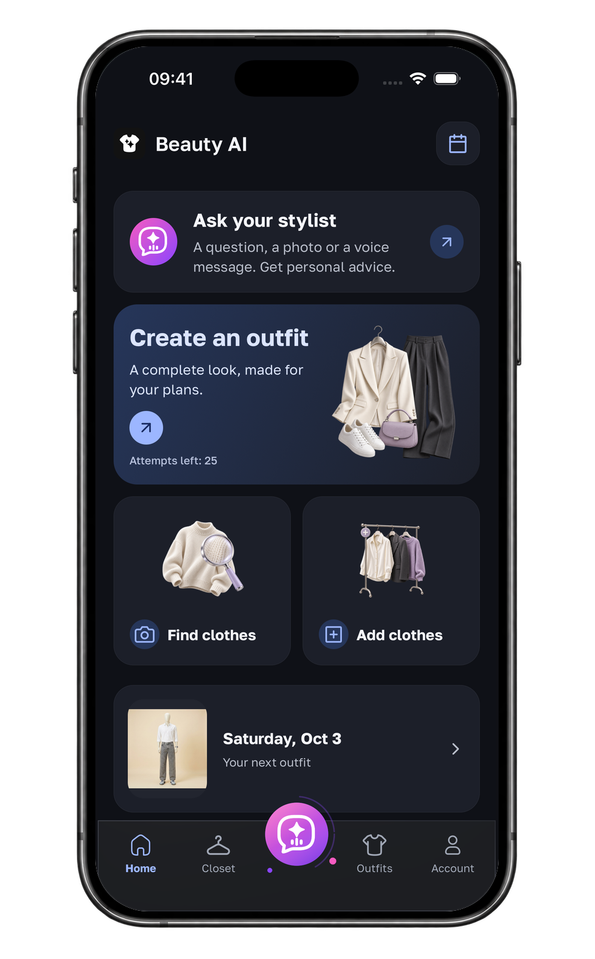
Find clothes from photos and screenshots
Start from TikTok, Instagram, Pinterest, product images, creator posts, or mirror photos when words are not enough to describe the garment.
Find Clothes From a Photo
Beauty AI helps you search clothes by picture, compare similar pieces, and decide whether the outfit actually works before you buy or recreate it.
TL;DR
Use Beauty AI when your photo search needs to become a real outfit decision. Google Lens is strong for broad visual matching, Pinterest Lens is strong for inspiration and similar shoppable ideas, and Beauty AI is strongest when you need to judge whether a result fits your style, wardrobe, color direction, occasion, and shopping plan.
Download Beauty AI to search clothes by picture, compare similar pieces, and turn saved photos or screenshots into smarter outfit and shopping decisions on iPhone or Android.
Find-clothes-from-photo searches convert because the user already has visual intent. The missing step is not more browsing; it is better judgment after the first match.
Start from TikTok, Instagram, Pinterest, product images, creator posts, or mirror photos when words are not enough to describe the garment.
Use broad visual search for discovery, then compare candidates inside a styling workflow instead of trusting the first product grid.
The best match is often the version that preserves silhouette, color balance, and outfit role, not necessarily the exact original product.
Use the page when you need a clothing finder app from picture input on mobile, not just a desktop reverse-image search.
Beauty AI helps decide whether the found item works with clothes you own instead of becoming another isolated purchase.
4.9 app rating
Beauty AI currently holds 39 app ratings and reviews across iPhone and Android, giving feature pages a stronger trust signal for install intent.
39 ratings and reviews across app stores
4.9 app rating
People download Beauty AI when they need a quick second opinion before work, events, travel, or content shoots.
4.9 app rating
The product works as both an AI stylist and an outfit planning app, which makes it more useful than inspiration-only tools.
4.9 app rating
Users can turn scattered style ideas into repeatable wardrobe decisions instead of relying on trial and error.
Trust and review process
This money page is kept tied to the live app experience, public store listings, and practical outfit planning workflows.
David Voskanyan, Software Developer. He personally writes, tests, compares, and reviews the Beauty AI blog's app roundups, workflow guides, and product evaluations.
June 3, 2026. We review feature pages when app capabilities, platform support, screenshots, or user-facing workflows change.
We checked whether the page accurately reflects the app flow, AI styling output, wardrobe use cases, app store positioning, install intent, and links to deeper supporting content.
| Source | Used for |
|---|---|
| Beauty AI App Store listing | Used for iPhone availability, public rating context, screenshots, and current app positioning. |
| Beauty AI Google Play listing | Used for Android availability, product description, screenshots, and install flow checks. |
| Beauty AI Editorial Standards | Used for source handling, review cadence, and the product evaluation process. |
Authority support
These pages strengthen topic authority, define core terms clearly, and make the site easier for both readers and answer engines to understand.
Comparison pages
These are the highest-priority head-to-head pages in the compare cluster.
Photo-search cluster
These pages route users into the exact next step: app comparison, Google Lens workflow, screenshot search, dress search, or full outfit finding.
To find clothes from a photo, start with the clearest screenshot or saved picture, crop around the item, run a broad visual search for exact or similar matches, then use Beauty AI to decide whether the result actually works as an outfit or purchase. This is the fastest path for queries like find clothes by picture, find clothes from photo, search clothes by image, and clothing finder app from picture.
The strongest workflow is not only upload photo and buy the first similar item. It is photo or screenshot -> exact and similar matches -> outfit fit check -> save, style, or skip. Beauty AI is built for that decision layer because it connects the found piece to your wardrobe, occasion, color direction, and styling goal.
A user who searches find clothes from photo, find clothes by picture app, or clothing finder app from picture has already seen something they want. The intent is not abstract inspiration. It starts from a visual reference and moves quickly toward buying, recreating, saving, or judging the look.
That is why this page should work as the money hub for the whole visual-search cluster. Blog pages can explain methods and tools, but this product page should make the action obvious: upload the image, compare possible matches, and use Beauty AI to decide the strongest next move.
The best app to find clothes by picture should solve discovery and judgment together. It should help identify exact products when possible, find similar clothes when the exact item is unavailable, and explain which option keeps the original outfit effect.
That is what separates a practical image-search app from a novelty upload tool. Real value appears when the image turns into a better purchase, a better outfit, or a clear decision not to buy.
Different tools solve different parts of photo clothing search. Google Lens is the best first pass for broad public web matches. Pinterest Lens is strongest for aesthetic direction and similar shoppable inspiration. Amazon visual search is useful when you already want Amazon results. Lykdat can help with fashion-specific reverse image search. Beauty AI is the stronger next step when you need to decide which result fits your outfit, wardrobe, occasion, and shopping plan.
That is the decision gap this page should own. Search tools help answer what is this or where can I buy something similar. Beauty AI helps answer should I wear this, buy this, save this, or look for a better substitute.
Beauty AI is stronger than a plain reverse-image workflow when the question is not only where the item came from, but whether the result is right for you. That evaluation layer prevents many weak purchases.
Instead of stopping at a rough visual match, Beauty AI helps users compare similar pieces, understand the original outfit, and translate inspiration into something wearable in real life.
This matters most when the original product is unavailable, expensive, or impossible to identify exactly. The better outcome is often not a duplicate. It is a smarter substitute that creates the same effect with less risk.
Users searching find clothes from photo do not all need the same answer. Some need a broad app comparison. Some need a how-to workflow. Some need a Google Lens explanation. Some need a dress-specific product page. Others need to find the full outfit, not only one item.
That is why this feature page works best as the central hub. It should pass users into the exact page that matches the next question instead of forcing every long-tail query into one generic answer.
Most users do this search on mobile because the image usually lives in Photos, screenshots, Instagram saves, TikTok, Pinterest, or a shopping app. A strong clothing finder app from picture should therefore work naturally for iPhone and Android behavior: save an image, open the app, upload or reference the look, and move into a decision quickly.
The phone workflow also changes the content need. Users do not want a long desktop-only reverse-image tutorial. They want the fastest path from a saved image to a shortlist of similar pieces, outfit logic, and a next action they can take now.
Most tools will find similar pieces more often than exact items. That is normal. Fashion search is messy because products go out of stock, screenshots are imperfect, and many outfits are memorable because of styling rather than one single product.
The best outcome is not perfect identification every time. It is a better decision after the search: buy a stronger alternative, recreate the look, or skip a weak purchase entirely.
This page is built for users searching find clothes from photo, find clothes by picture, search clothes by image, clothes finder by image, clothing finder app from picture, and similar commercial queries with immediate intent to act.
If your style journey usually starts with saved visual inspiration, Beauty AI is a strong starting point because it connects image search to real wardrobe, outfit judgment, and buying decisions.
HowTo
The best workflow starts with a clean image, then moves from visual discovery into outfit judgment.
1
Use a screenshot, product photo, mirror photo, or saved outfit where the target garment, color, and silhouette are easy to read.
2
Search the main garment for product matches, then review the full look so you understand the styling logic behind the image.
3
Use Beauty AI to compare similar pieces by silhouette, color, wardrobe fit, occasion, and whether the item is worth buying.
Yes. A good clothing finder app can use a picture to return exact items, close visual matches, similar pieces, or the outfit logic needed to recreate the look.
The best choice depends on the job. Google Lens is strong for broad web matches, Pinterest Lens is strong for inspiration, and Beauty AI is strongest when you need to judge whether a match works as a real outfit or wardrobe decision.
Yes. Crop the screenshot around the main garment, search the item first, then search the full outfit if you need styling context. Screenshots from TikTok, Instagram, and Pinterest often need more than one frame.
Yes. AI and visual search tools can find similar clothes from a photo, but the best workflow also compares silhouette, fabric, color, occasion, and wardrobe fit before buying.
Yes. The page is built for mobile visual-search behavior, including photos, screenshots, saved social looks, and product images on iPhone or Android.
No. Exact matches depend on whether the item is still indexed, visible, and available online. Often the stronger outcome is a similar piece that recreates the same effect with less friction.