

Cardigan outfits become easier when you match the cardigan's length to an outfit you already like. Try a cropped knit with high-rise jeans, a hip-length cardigan over a tee and straight trousers, or a longline style over an easy dress. I would decide whether to wear it open or buttoned before adding accessories: that choice changes how much of the base outfit remains visible. You do not need a tight top, a tucked waist or new shoes to make it work. This guide gives you twelve complete combinations and practical fixes; Beauty AI can help review your finished version.
I have organized the looks around the garment, not body-type rules. Use them as suggestions you can adapt to your coverage and comfort preferences. Both images are AI-generated illustrations, designed to explain the combinations rather than document personal wear tests.
Which cardigan are you working with?
Put yours on over a familiar tee and check where it actually ends. Retail labels such as “cropped” and “long” are only a starting point: the same cardigan can meet different places on different people.
- Cropped or waist length: useful when you want the trousers or skirt to remain visible. A longer tee underneath can supply coverage without a tuck.
- Hip length: a flexible option worn open over a shirt, or buttoned as a top when the knit and fastening provide the coverage you want.
- Longline: a cardigan extending down the thigh or toward the knee. Look at how its hem moves around your skirt, trouser pockets and seat.
- Oversized: describes volume, not necessarily length. Check roomy sleeves and shoulders separately from the hem. A short cardigan can still be oversized.
Then assess knit weight. I would pair a substantial cable knit with a base that moves freely underneath, not automatically something skin-tight. A finer cardigan can sit closer to a shirt without as much bulk. In either case, test the actual layers by bending your elbows and reaching forward.
Four cardigan outfits with jeans
1. Buttoned oatmeal cardigan, indigo jeans and burgundy flats
Choose a waist-length oatmeal cardigan, high-rise straight indigo jeans and burgundy ballet flats. Wear the cardigan as the top only if the knit is opaque enough and the buttons sit comfortably. Its short edge leaves the jeans' shape clear without tucking. I like the small shoe-color change here more than another accessory. Use what you own: any dark flats work, and a thin tee underneath gives more coverage without changing the idea.
2. Red hip-length cardigan over a gray tee
Wear a red cardigan open over an untucked gray tee, relaxed blue jeans and white sneakers. The gray gives the red a quiet background; the open front keeps it from becoming one large block. Leave both layers loose if that is your preference. Substitution: use a blue or green cardigan instead. If the tee hangs longer than you like, try a shorter tee you already own rather than packing it into your jeans.
3. Long camel cardigan with charcoal jeans
Try a thigh-length camel cardigan, cream crewneck tee, straight charcoal jeans and black ankle boots. Keep the cardigan open and the tee untucked. The lighter middle layer makes the garment edges easy to see, while the straight jeans allow an all-loose silhouette. This suits an unhurried weekend outing. Substitution: ordinary blue denim and your comfortable trainers work too. Check that a long sleeve does not catch on a bag strap or cover your hands inconveniently.
4. Oversized navy knit with ecru jeans
Put an oversized navy cardigan over a striped cotton top, ecru straight jeans and brown loafers. Let the cardigan supply the volume; leave the striped top visible through an open front. Ecru separates the jeans from the dark knit without demanding fitted clothing. Substitution: a plain ivory tee can replace the stripes. I would keep the loafers if they are comfortable, not add a heel merely because the cardigan is roomy.
Match the hem, bottom shape and shoe
| Cardigan hem | Bottom shape | Shoe option | Check before leaving |
|---|---|---|---|
| Waist | Wide trousers or A-line skirt | Flats or loafers | Coverage when you reach up |
| Upper hip | Straight jeans | Low-profile sneakers | Whether the ribbed hem rides up |
| Low hip | Relaxed trousers | Loafers | Buttons and pockets sitting freely |
| Thigh | Straight midi skirt | Flat ankle boots | Layers moving without catching |
| Knee | Straight pants or a simple dress | Flats or slim-shaft boots | No hem dragging or snagging |
These are starting combinations, not a rule that a short person needs a short cardigan or a long cardigan requires skinny jeans. I would judge the actual outfit from the front and side, then while seated. A silhouette you enjoy matters more than creating a prescribed body shape.
Four combinations with trousers
5. Navy cardigan, gray tee and charcoal straight trousers
For a relaxed workplace, combine a hip-length navy fine knit with a light-gray tee, charcoal straight trousers and black loafers. Leave the cardigan open so the tee separates the two darker colors. The straight trouser line supplies structure without a rigid blazer. Substitution: your normal work shirt can replace the tee if there is enough sleeve room. Follow your workplace's actual dress code; a cardigan does not make every base outfit office-appropriate.
6. Cropped gray cardigan with wide navy trousers
Choose wide navy trousers, a gray cardigan buttoned over a thin matching shell, and almond-toe flats. Let the cardigan finish at or slightly below the waistband, keeping the front smooth rather than tucked. Its clear horizontal edge makes the wider leg shape easy to read. Substitution: wear a longer gray cardigan open over an untucked shell. This keeps the relaxed feel without needing to crop a garment or expose your waist.
7. Olive longline cardigan with cream separates
Use an open knee-length olive cardigan, a cream tee, relaxed ecru trousers and tan flat ankle boots. The light base remains visible on either side of the open front, and the boots give the trouser hems a clear endpoint. This is a useful all-loose option for a café or informal lunch. Substitution: light-gray trousers and a white tee do the same job. Avoid deep, loaded cardigan pockets if they pull the front unevenly.
8. Black fine knit, pleated stone trousers and metallic flats
For dinner, pair a hip-length black fine-knit cardigan with pleated stone trousers and silver flats. Button it as a top, or wear it open over a black shell if that is more comfortable. Leave the pleats free of a thick tucked hem. The small metallic shoe detail changes the mood without adding another layer. Substitution: black flats and one silver earring work just as well; neither sparkle nor a matching bag is essential.
Compare three lengths over the same base
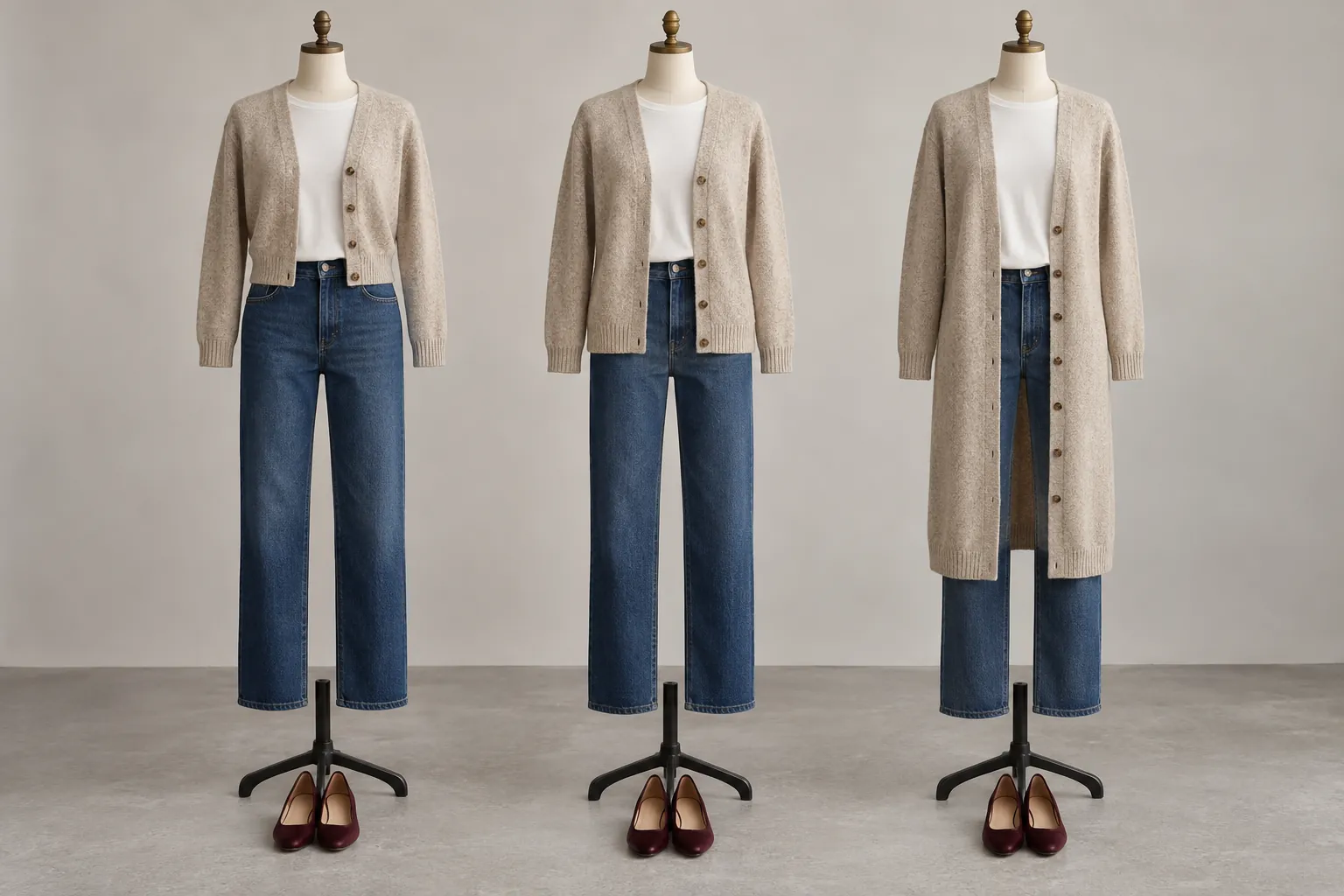
The waist-length version reveals the tee's hem as a separate edge. The hip-length version frames a smaller section of the tee. The longline version creates two extended panels beside the jeans. None is inherently correct. If the extra tee edge bothers you in the first version, try a top of a similar length; if you enjoy the layered outline, keep it. I would not tuck solely to erase a line someone else dislikes.
Four looks with skirts and dresses
9. Cropped blue cardigan with a navy A-line skirt
Wear a cropped blue cardigan over a thin ivory top with a navy A-line midi skirt and navy flats. Keep the knit's hem close to the skirt's waistband so the skirt can open out freely below it. This works for lunch or a casual office when appropriate. Substitution: use a hip-length cardigan open. A short layer is one option, not a reason to reject the cardigan already in your drawer.
10. Relaxed cream knit with a burgundy straight skirt
Combine a relaxed cream cardigan, a cream crewneck base, a burgundy straight midi skirt and dark loafers. Wear the knit open and untucked. The skirt gives the outfit a relatively simple outline while the cardigan supplies softness; neither garment needs to cling. Substitution: a straight denim skirt and sneakers make this a more casual combination. Check the skirt's stride length and the cardigan's sleeve comfort before making it a walking-day outfit.
11. Short black cardigan over a printed midi dress
Try a waist-length black cardigan worn open over an ivory-and-black printed midi dress, with black flat slingbacks. Repeating a color from the print makes the layer easy to place, while the short hem leaves the dress's shape visible. I would keep jewelry simple and let the print lead. Substitution: use any plain cardigan that repeats one existing print color. An opaque tee-dress works if you prefer a less delicate base.
12. Long gray cardigan over a blue shift dress
Pair a long gray fine-knit cardigan with a loose blue shift dress and black ankle boots. Wear the front open, allowing the dress to move independently. The difference in length can be deliberate; the two hems do not have to match exactly. This is a no-tuck, no-fitted-base option for an informal evening. Substitution: a simple shirt dress and flats work. If the hems repeatedly catch together, choose the cardigan with a smoother drape.
Open, buttoned or over a base layer?
Open is the first option I would try when the cardigan pulls at the chest or you want to show a printed base. Buttoned as a top suits a cardigan whose neckline, knit density and fastening give you comfortable coverage. Check it in the light where you plan to wear it, including while seated. Over a base provides another coverage option and means you can remove the cardigan without changing outfits.
For work, keep a complete workplace-appropriate base underneath. For weekends, you may prefer more relaxed hems and practical shoes. For evening, try changing the shoe or one accessory instead of adding layers. My easy outfit formulas explain that broader approach; the color combinations guide can help when your cardigan is the bright piece.
Fix the cardigan, not your body
- Buttons gape: wear the cardigan open over a suitable base. If you need it closed, try a different fit or fastening arrangement. Stretching it tighter is not a styling solution.
- The tuck feels bulky: untuck it. Try a shorter base or open front before adding a belt. A thick ribbed edge does not need to live inside a waistband.
- Several hems compete: remove one layer, align two edges more closely, or make their difference obvious. Choose the effect you like instead of treating every visible shirt hem as a mistake.
- Sleeves feel trapped: reduce the base layer's sleeve volume or choose a roomier cardigan. You should be able to bend your arms freely.
- A heavy knit has lost its outline: check storage and care before deciding it needs replacing. Woolmark advises folding knitted wool garments; always follow your garment's own care label.
Four common cardigan questions
Can I wear a cardigan without a shirt underneath?
Yes, when its knit, neckline and fastening provide the coverage and comfort you want. Check opacity and button gaps in ordinary light. If you are unsure, a lightweight base gives you a simple alternative.
How can I wear a long cardigan without skinny jeans?
Try straight trousers, relaxed jeans or a loose simple dress. Keep the front open if you want the base visible, and check the hems in motion. A long cardigan does not require a close-fitting bottom.
Do I have to tuck a cardigan into trousers?
No. A free-hanging hem, a waist-length cardigan or an open cardigan over an untucked base all work. I would only tuck when it feels comfortable and creates an outline you actually prefer.
Can a cardigan replace a blazer for work?
Sometimes. A fine-knit or more structured cardigan can suit a business-casual environment, but it may not meet a formal dress code. Keep your employer's requirements and the day's meetings ahead of the styling suggestion.
Choose the version worth repeating
Start with one base outfit and compare your cardigan open and buttoned, or compare two lengths. Through Beauty AI's AI stylist app, you can ask for feedback on the visible hems, color balance or shoes. Check comfort and coverage yourself; a photo cannot establish either. Then keep your preferred combination in Beauty AI's outfit planning workflow. My goal is a cardigan you reach for confidently, not a new list of pieces you feel obliged to buy.


